
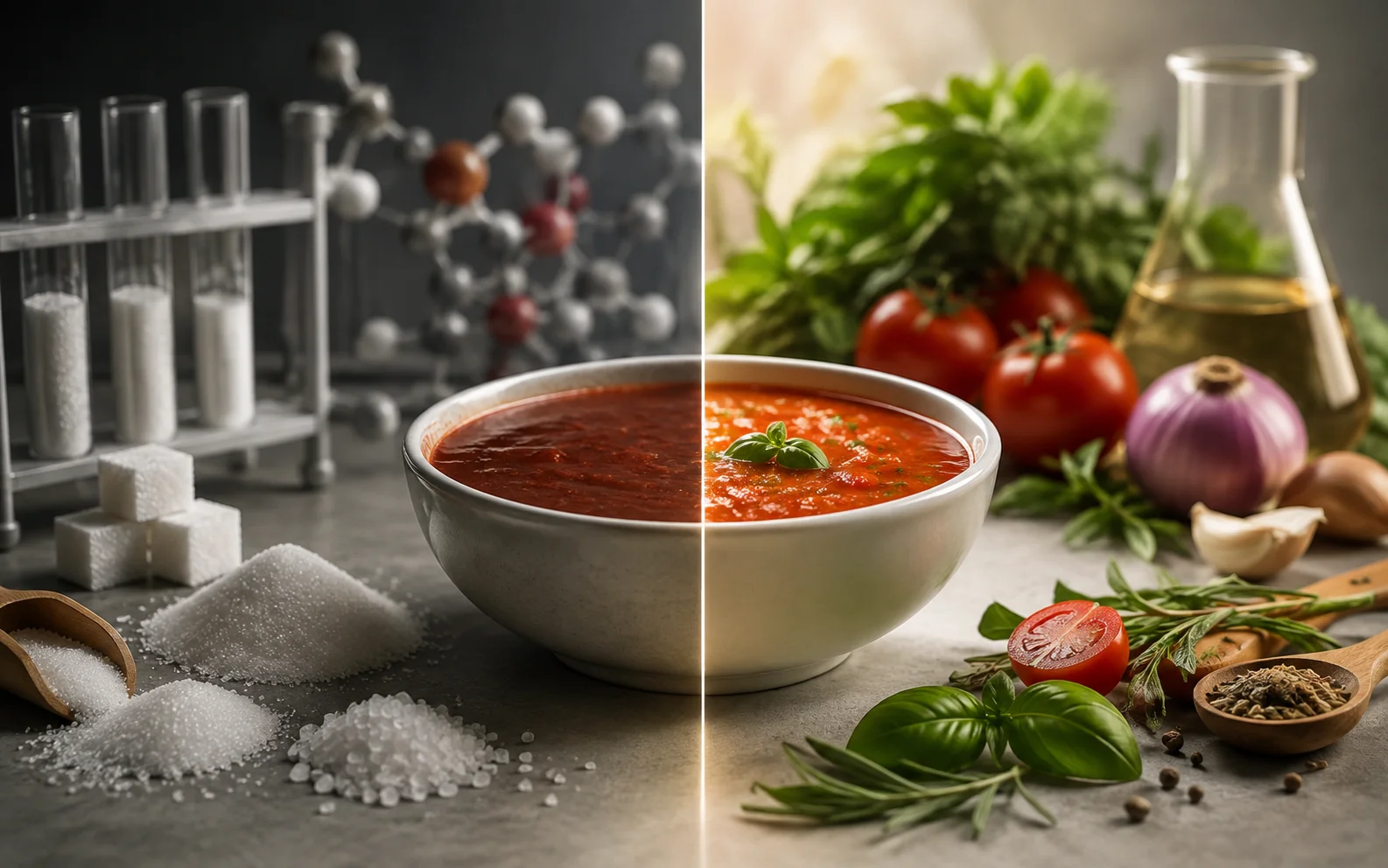
Key takeaway: Under Singapore’s Nutri-Grade system, beverages are graded A to D on sugar and saturated fat, and any beverage graded C or D must carry the Nutri-Grade mark on front-of-pack. Grade D beverages cannot be advertised. From mid-2027, the Health Promotion Board is extending Nutri-Grade labelling and advertising prohibitions to 23 sub-categories of prepacked salt, sauces, seasonings, instant noodles and cooking oils. Reformulating to move up a grade is rarely a simple subtraction, because sugar and salt do far more in a formulation than deliver sweetness and saltiness. They carry aroma, build body, and suppress bitterness. Removing them exposes flaws that were always there, which is why sugar and sodium reduction is a flavour problem before it is a nutrition problem.
What Nutri-Grade actually requires
Nutri-Grade is a mandatory front-of-pack labelling and advertising regime administered by Singapore’s Health Promotion Board under the Food Regulations. It has applied to pre-packaged beverages and non-customisable automated dispensers since 30 December 2022, and to freshly prepared beverages since 30 December 2023.
Beverages are graded on two nutrients of concern, sugar and saturated fat. The final grade is set by whichever nutrient scores worse. The sugar thresholds are:
| Grade | Sugar content per 100ml |
|---|---|
| A | 1g or less, and no sweetener |
| B | More than 1g up to 5g |
| C | More than 5g up to 10g |
| D | More than 10g |
Beverages graded C or D must display the Nutri-Grade mark on the front of pack, or next to the item on the menu in the case of freshly prepared drinks. Labelling is optional for grades A and B. Advertising of Grade D beverages is prohibited across broadcast, print, out-of-home and online media, with a narrow exception for point-of-sale material inside variety shops.
The commercial consequence is straightforward. A Grade D product loses its right to be advertised. That alone has driven reformulation across the Singapore beverage category.
The 2027 extension is the one to plan for now
The more significant development for most manufacturers is what is coming next.
The Ministry of Health has confirmed that from mid-2027, Nutri-Grade labelling requirements and advertising prohibitions will extend to key contributors of sodium and saturated fat intake. The measures will cover 23 sub-categories of prepacked salt, sauces, seasonings, instant noodles and cooking oils sold in retail settings, a group the authorities refer to as SSSIO.
Three features of the extension matter for formulators:
- Grading is differentiated by sub-category. Rather than one universal threshold, each sub-category has its own thresholds, which is designed to drive reformulation within a category rather than push products out of it.
- The label will name the offending nutrient. The updated Nutri-Grade mark will call out which nutrient of concern drove the grade. This updated design will apply to beverages as well.
- Grade D products cannot be advertised. The same advertising prohibition that reshaped the beverage aisle now arrives in the sauces and seasonings aisle.
Reformulation cycles in savoury run long. Sensory validation, shelf-life confirmation and production trials on a soy sauce, a seasoning blend or an instant noodle base are not a one-quarter exercise. Manufacturers who begin scoping in 2026 will make the deadline comfortably. Those who begin in 2027 will be reformulating under pressure, which is when quality gets sacrificed.
Why sugar reduction is a flavour problem, not a sweetness problem
The most common mistake in reformulation is treating sugar as a sweetener that can be swapped out at equivalent sweetness intensity. Sucrose is doing at least four other jobs in your formulation.
It builds body and mouthfeel. Sugar contributes viscosity and density. Remove it and a beverage becomes thin and watery on the palate, a defect consumers describe as tasting “diluted” even when the flavour dosage is unchanged.
It carries and releases aroma. Sugar concentration affects the partition of volatile aroma compounds between the liquid and the headspace. Change the sugar level and you change how much aroma reaches the nose, and in what order. A flavour that was balanced at 10g of sugar per 100ml will present differently at 4g.
It suppresses bitterness and acidity. Sucrose masks bitter and sour notes. Many raw materials, including fruit juices, cocoa, tea and coffee extracts, and botanical extracts, carry bitter fractions that sugar was quietly hiding. Cut the sugar and those notes step forward.
It shapes the temporal profile. Sucrose has a clean onset and a clean finish. High-intensity sweeteners do not. Steviol glycosides and sucralose have a delayed onset and a lingering sweet, sometimes bitter or metallic, aftertaste. The product no longer finishes cleanly.
The result is familiar to anyone who has tasted a poorly executed sugar-reduced beverage. It is thin, the fruit note is muted, there is a bitter edge that was not there before, and the sweetness hangs around too long.
The flavour toolkit for sugar reduction
Fixing this is a flavour engineering problem, and it is addressed with a set of tools rather than a single ingredient.
Sweetness modulators and enhancers amplify the perception of the sweetness that remains, allowing you to hold perceived sweetness while reducing actual sugar.
Bitterness maskers and off-note blockers suppress the bitter and metallic notes that high-intensity sweeteners introduce, and the bitter fractions that sugar was previously hiding.
Mouthfeel and body builders restore the palate weight lost with the sugar solids, addressing the “watery” defect directly.
Top-note reinforcement compensates for the change in aroma release, rebuilding the fresh, bright impression that reads as fruit character.
Cooling and freshness systems are frequently underused. Mint derivatives and cooling agents create a perception of freshness and clean finish that can offset the lingering sweetness of high-intensity sweeteners. This is well established in oral care and confectionery and translates directly into beverages, particularly tea, citrus and water-plus categories. Norex’s mint products range covers menthol crystals, peppermint and spearmint oils, and mint derivatives used in exactly this role.
A well-designed reduction programme uses several of these together. Norex’s flavour portfolio and aroma chemicals range are the building blocks, and the in-house R&D and applications capability is where the combinations get resolved against a specific base.
Do not solve one nutrient by worsening the other
A trap specific to Nutri-Grade: the grade is determined by the worse of the two nutrients of concern. It is entirely possible to cut sugar successfully, restore mouthfeel using a fat-based or dairy-based body builder, and land in the same grade because saturated fat has risen. Any reformulation brief should model both nutrients simultaneously, not sequentially. HPB publishes a Nutri-Grade calculator for this purpose, and it should be run at every iteration, not just at the end.
The 2027 savoury problem is harder than the beverage problem
Sodium reduction is more difficult than sugar reduction, for a simple reason. There is no high-intensity substitute for salt that behaves like salt.
Sodium chloride delivers saltiness, but it also suppresses bitterness, enhances perceived thickness, extends shelf life, and carries savoury character. Potassium chloride, the most common partial substitute, replaces the ionic saltiness but introduces a distinct bitter and metallic note of its own.
The workable approaches are:
- Umami and kokumi systems, which increase the perception of savoury depth and fullness, allowing sodium to come down while the product still tastes complete.
- Salt perception enhancers, which amplify the saltiness of the sodium that remains.
- Bitterness maskers, specifically targeted at the potassium note where KCl is used.
- Savoury and reaction flavour reinforcement, rebuilding the roasted, meaty and brothy character that sodium reduction flattens.
Saturated fat reduction in the same categories brings its own problem, because fat carries lipophilic aroma compounds and delivers them slowly across the palate. Cut the fat and the flavour arrives too fast and disappears too early. Rebuilding a natural-tasting release curve in a lower-fat base is a formulation discipline in its own right.
What to ask your flavour supplier
If you are scoping a Nutri-Grade reformulation, these are the questions that separate a supplier who can help from one who can only ship material.
- Can you demonstrate the flavour system in my actual base, at my target sugar or sodium level, rather than in a model solution?
- What is your approach to the specific off-note my sweetener system introduces?
- Can you support both the sugar and the saturated fat side of the calculation, or will fixing one worsen the other?
- Is the flavour compliant with the Singapore Food Regulations, and can you provide full documentation?
- Is it halal certified, and is it suitable for my export markets as well as Singapore?
- What is the stability of this system across my shelf life in tropical storage conditions?
That last point is not incidental. A reformulated product with a rebuilt top-note structure can lose that structure to oxidation faster than the original did. We cover this in detail in Formulating for the Tropics.
Where to start
The practical sequence for a Singapore manufacturer today:
- Now: Grade your current SSSIO portfolio against the published thresholds and identify which products land in C or D.
- Next quarter: Prioritise the products where a Grade D advertising prohibition would do commercial damage.
- Within 12 months: Run flavour system trials in the real base, not a model system, and validate over full shelf life.
- By early 2027: Lock formulations, complete production trials, and finalise artwork.
Reformulation is not a labelling exercise that happens at the end. It is a product development exercise that happens now.
Norex has supplied flavours, mint products, essential oils and aroma chemicals to the food, beverage, personal care and pharmaceutical industries since 1994, with quality systems and certifications built for regulated markets. If you are scoping a Nutri-Grade reformulation, talk to our applications team and request samples against your specific base.
Frequently asked questions
Nutri-Grade is Singapore’s mandatory front-of-pack labelling and advertising regime for beverages, administered by the Health Promotion Board. Beverages are graded A to D based on sugar and saturated fat content. Products graded C or D must display the Nutri-Grade mark, and Grade D products cannot be advertised.
Grade A is 1g of sugar or less per 100ml with no sweetener. Grade B is more than 1g up to 5g per 100ml. Grade C is more than 5g up to 10g per 100ml. Grade D is more than 10g per 100ml. The final grade is set by whichever of sugar or saturated fat scores worse.
Health will extend Nutri-Grade labelling requirements and advertising prohibitions to 23 sub-categories of prepacked salt, sauces, seasonings, instant noodles and cooking oils sold in retail settings.
Sugar does more than sweeten. It builds body and mouthfeel, affects how aroma compounds release into the headspace, suppresses bitterness, and gives a clean temporal profile. Removing it makes a product taste thin, mutes the aroma, exposes bitter notes, and, where high-intensity sweeteners are used, adds a lingering aftertaste. These effects are corrected with flavour modulators, maskers, mouthfeel builders and top-note reinforcement.
Yes. Umami and kokumi systems increase perceived savoury depth, salt perception enhancers amplify the saltiness of the remaining sodium, and bitterness maskers suppress the metallic note introduced by potassium chloride substitution. Reaction and savoury flavours rebuild the roasted and brothy character that sodium reduction flattens.